
By Make Votes Matter CEO Emma Harrison
First Past the Post was built for a two-party country. Britain isn’t one any more, and for the first time, a Prime Minister has said so from the conference stage.
On 29 September 2026, in his first Labour conference speech as Prime Minister, Andy Burnham announced a new National Commission on Electoral Reform, inviting every political party to take part, and committed Labour to fighting the next general election on a manifesto pledge to change the voting system. “Our voting system is bust,” he told delegates in Liverpool. It’s the moment campaigners have pushed for across two decades, and it didn’t come from nowhere.
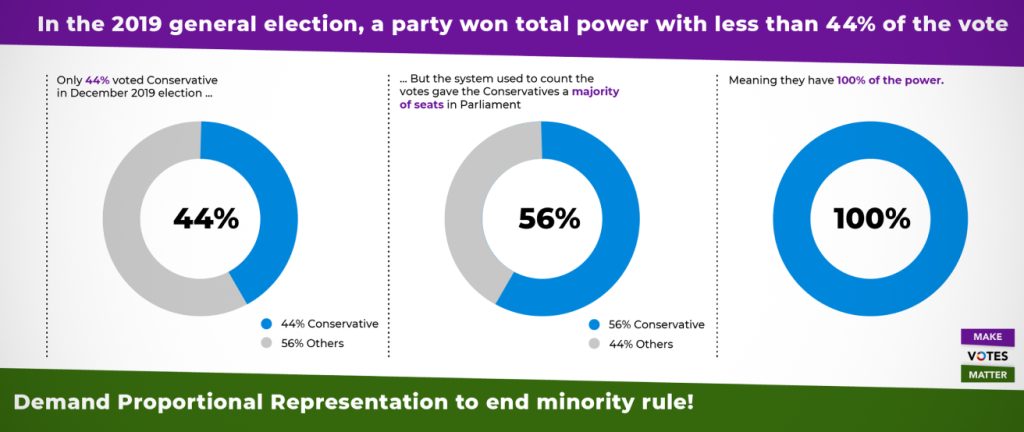
The 2024 general election delivered the most disproportionate result in British history: a majority government elected on the support of just over a third of voters. That’s not a one-off distortion. It’s the latest point on a decades-long trend of fragmenting votes and a widening gap between how people vote and who governs them. The 2026 local elections confirmed it. Left unaddressed, that gap erodes public trust and leaves politics increasingly volatile. Burnham’s commission is the government’s answer.
And the sceptics who say “reform never happens here” were already wrong before this announcement. Britain has done this before: not for Westminster’s voting system, but for the shape of the constitution. The model that worked then is now, finally, the model on the table for the vote itself.
How we got here
This was never a fringe demand. A record 60% of the public want to change the voting system, according to the latest British Social Attitudes (BSA) survey, a majority that has held in every BSA survey since 2021. A majority of every major party’s supporters back reform. Earlier this year, more than a quarter of MPs, signed an amendment to the Representation of the People Bill, tabled by Labour backbencher and APPG Chair Alex Sobel MP, calling for this commission. It became the most-signed amendment to any bill since the 2024 election.
Burnham himself has been consistent about where he stands. A year before the announcement, as Mayor of Greater Manchester, he told a Labour for a New Democracy rally that proportional representation was “an idea whose time has come”. In his conference speech this year, he reminded delegates: “In past years, you have voted twice to support electoral reform. And today I am announcing a new National Commission on Electoral Reform.” The government had already scrapped First Past the Post for mayoral and police and crime commissioner elections, proof that Westminster had conceded the principle before turning to its own elections.
What had been missing wasn’t public appetite, party support, or leadership sympathy; it was a government willing to commit to a credible, independent process.
This isn’t a leap into the unknown: it’s a proven model
Sceptics of any big reform tend to ask the same question: has this ever actually worked? To be precise, no independent commission has changed Westminster’s voting system before. Burnham’s commission would be the first. But the claim isn’t that Britain has done this exact thing before. It’s that this model, an independent commission or deliberative body converting evidence and public consent into real legislative change, has a strong track record, both in fixing voting systems abroad and in reshaping Britain’s own constitution.
Elsewhere, this model has fixed a voting system directly. In 1985, New Zealand’s government established an independent Royal Commission on the Electoral System after years of elections in which the party with more votes won fewer seats. The Commission’s 1986 report, Towards a Better Democracy, recommended replacing First Past the Post with a Mixed Member Proportional (MMP) system. Neither major party supported the change at the time. But sustained public pressure, built off the back of the Commission’s independent evidence, forced an indicative referendum in 1992, where 84.7% of voters backed change, followed by a binding referendum in 1993 that adopted MMP outright. New Zealand has run every election since on the system that one independent commission first proposed.
In Britain, the same model has already reshaped the constitution, just not yet the vote. The devolution settlements that changed the shape of the UK were built exactly this way, through independent or cross-party bodies with no power to legislate, whose recommendations Parliament nonetheless enacted almost wholesale:
- The Scottish Constitutional Convention (1989–1995), a cross-party civil-society body outside government, designed the devolution model that became the Scotland Act 1998, establishing the Scottish Parliament.
- The Calman Commission (2008–2009), an independent cross-party review, recommended new powers for Holyrood that were enacted in the Scotland Act 2012.
- The Smith Commission (2014), convened after the independence referendum, produced recommendations that became the Scotland Act 2016.
- The Silk Commission (2011–2014) did the equivalent for Wales, its recommendations feeding into the Wales Act 2014 and Wales Act 2017.
None of these bodies had the power to legislate. What they had was independence, evidence, and public legitimacy, enough to make the political class act. That is precisely the theory of change behind Burnham’s commission: apply a model Britain already trusts for constitutional questions to the one constitutional question it has never yet been applied to.
Even the near-miss is instructive rather than discouraging. The Jenkins Commission of 1998 produced a serious, evidence-based proposal for electoral reform, the Alternative Vote Plus (AV+), but it was shelved. It never had the sustained cross-party and public pressure that reformers in New Zealand and Scotland built around their own commissions. The lesson isn’t that commissions don’t work. It’s that they need exactly what today’s moment already has: broad public demand, cross-party backing, and a government minded to act on the outcome. That combination didn’t exist in 1998. It exists now.
Getting the design right
The principle is won. The design is still up for grabs. The draft terms of reference from the All-Party Parliamentary Group (APPG) for Fair Elections are a strong starting point for how the commission should actually work. The APPG recommends a tripartite structure comprising an independent panel of commissioners to steer the process impartially, an expert panel to provide politically impartial evidence, and a Voters’ Forum, a citizens’ assembly that will hear the options, deliberate, and make recommendations.
While we support the thrust of the terms of reference, we think a couple of tweaks are needed to make sure the commission genuinely engages with voters.
Public engagement should be mandatory, not optional. Regional deliberation shouldn’t be a nice-to-have. It should be a floor. The commission should hold at least one regional listening event in each of Scotland, Wales, Northern Ireland and every English region. A reform process about whether people’s votes count shouldn’t be run entirely from Westminster. It needs to be visibly, physically rooted outside it, the way the Scottish Constitutional Convention was.
The Voters’ Forum needs a geographic quota, not just an abstract commitment to diversity. Diversity of the electorate as a selection principle can still produce a forum dominated by England’s larger population centres if left to population-weighted sampling alone. The roughly 100 members of the Voters’ Forum should be drawn from every nation and region of the UK, with guaranteed minimums for the smaller nations, so Scotland, Wales and Northern Ireland aren’t swamped by numbers alone.
For a devolution-first Prime Minister, this isn’t a distraction from the mission. It is the mission, applied one level up. Electoral reform and devolution are the same argument at different scales: both ask whether people’s votes translate into real influence over the decisions that shape their lives.
What happens next
The commission is announced. Here is what it has, and what it still needs:
- Cross-party participation, with every party invited and more than a quarter of MPs already on record backing the idea before the announcement even came.
- A clear deadline. The commission must report before the next general election, so there is a defined window to hold the government to.
- A design fight still to be won: on regional engagement, on the Voters’ Forum’s composition, and on what “before the next election” actually means. And,
- A manifesto commitment. Burnham has promised one, locking Labour into fighting the next election on a pledge to change the voting system.
Britain has used this model before, on questions just as contested as this one, and the laws followed. The question now isn’t whether a commission will happen. It’s whether campaigners, parties and the public hold the government to a commission that’s genuinely independent, genuinely national, and genuinely followed by a vote in Parliament.
Yes, we did get the commission. Now we need to see it through.