The way we elect our mayors matters.These leaders control major decisions about transport, housing, policing, and regional investment. Given that they face no formal opposition in office, it’s incredibly important that they aren’t elected on a tiny mandate.
That’s why the government’s decision to restore the Supplementary Vote (SV) is more than a procedural tweak – it’s a vital course correction. It acknowledges what voters have long known: First Past the Post (FPTP) fails our democracy, and it has damaged public trust in the system itself. We must however, recognise that SV, though an improvement on First Past the Post, is not a proportional system.
Whilst Make Votes Matter campaigned to prevent the implementation of FPTP in 2022, and have campaigned for the removal of FPTP for Mayoral elections, SV is not considered a system that passes the Good System’s agreement, and there are more proportional options out there. We do, however, welcome the recognition that FPTP is unsuitable for elections to any elected position in UK politics. This blog will put the two systems in context and explain how this impacts the wider campaign for fair votes.
FPTP: A System That Fails Voters
The results speak for themselves:
- In the 2024 mayoral elections – the first held under FPTP – only five out of ten winning candidates received a majority of votes. One won with just 35% support.
- In this year’s elections, the picture was even worse: none of the six winning candidates secured a majority. One mayor won with just 25% of the vote – meaning three-quarters of voters backed someone else.
- On average, mayors elected in May 2025 received less than 30% of the vote.
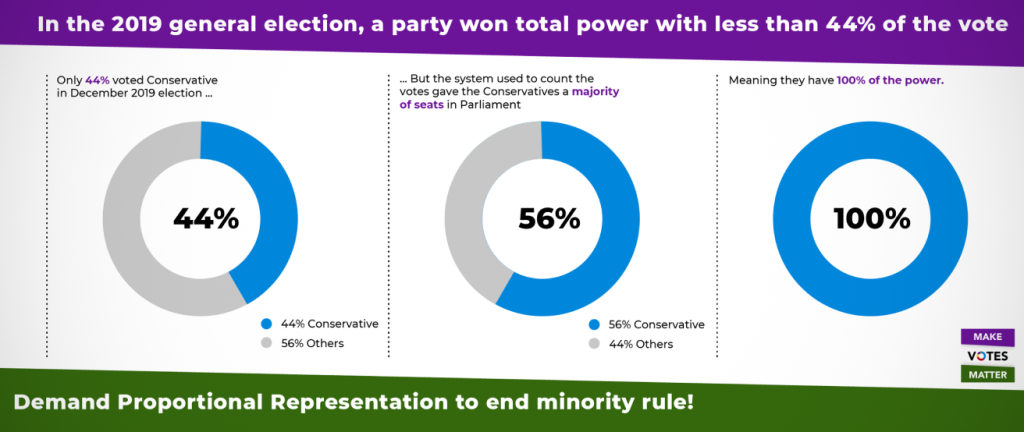
This is not democratic legitimacy. It’s electoral distortion. These outcomes highlight how FPTP undermines the basic idea that power should rest with the majority. It entrenches minority rule and deepens disillusionment.
How Does the Supplementary Vote Work?
The Supplementary Vote goes some way to changing this. It gives voters the ability to rank a first and optional second choice. Here’s how it works:
- If any candidate receives more than 50% of first-choice votes, they win outright.
- If not, only the top two candidates remain.
- Ballots for eliminated candidates are re-checked. If a voter’s second preference is for one of the top two, it’s added to their total.
- The candidate with the highest total wins – with a majority of support from participating voters.
When compared with FPTP, SV reduces the chances of mayors being elected on a tiny share of the vote. It reduces the pressure to vote tactically and lets people vote honestly – for who they believe in.
A Necessary Step Toward Restoring Trust
The restoration of SV is not just about electoral mechanics – it’s about starting the process of rebuilding trust in our politics.
FPTP breeds cynicism. When leaders are elected by a tiny fraction of voters, it feeds the sense that politics doesn’t work, that votes don’t count, and that outcomes are disconnected from public will. SV helps reverse that damage by raising the bar for elections.
It will also change how campaigning is done. Candidates under SV must appeal beyond their base to earn second-choice support. That encourages the need to campaign for every vote, leading to a more constructive debate, and unifying approach to leadership.
Tried And Tested
SV is far from untested:
- It was used to elect London’s mayor for two decades
- US cities like New York and San Francisco use ranked-choice voting – a close cousin of SV – to ensure more representative results
Looking Ahead: Democracy That Reflects Us
Restoring the Supplementary Vote is a crucial acknowledgement that FPTP has failed voters, and that trust won’t return while minority rule remains the norm.
This reform is the first step in democratic correction, but we must continue to build from here. It gives voters more choice, leaders more legitimacy, and puts our politics on a path back to credibility. Now, we urge the government to continue on this journey, by addressing the democratic deficit at the heart of our politics in Westminster, by making sure all votes matter.