By Make Votes Matter CEO Emma Harrison.
On 14 September 2026, the House of Lords held the Second Reading debate on the Government’s Representation of the People Bill. Nearly fifty peers spoke over more than five hours. It was a debate that touched on almost every corner of our democracy – except, tellingly, the one at its foundation: the voting system itself.
Here’s what the Bill does, what peers said, and why the case for a fair voting system kept surfacing anyway, even when nobody had put it on the agenda.
What’s in the Bill
Introducing the Bill, Baroness Taylor of Stevenage, the responsible minister, framed it as an effort to “renew our democracy for a new generation” and restore public trust in politics. Its headline measures include:
- Votes at 16 and 17 for UK parliamentary elections, bringing the rest of the UK into line with Scotland and Wales
- Automatic voter registration, aimed at the estimated 6–8 million eligible people currently missing from the electoral register
- Wider forms of voter ID, including bank cards
- A ban on crypto-asset political donations, and a £100,000 annual cap on donations from overseas electors
- A shift in the test for company donations from revenue to profit
- Stronger powers for the Electoral Commission, including the repeal of the Government’s power to direct it via a strategy and policy statement
- Tougher sentencing for abuse and intimidation of candidates and election staff
Much of this responds to the Rycroft review into foreign financial interference in UK politics, commissioned after cases like the conviction of Nathan Gill for accepting Russian money.
A debate overshadowed by £72 million
The timing gave the debate an unusually sharp edge. Just days before Second Reading, it emerged that two individual donors had given a combined £72 million to Reform UK within 24 hours. Peer after peer – from Lord Wallace of Saltaire to Baroness Hodge, Lord Wills, Lord Rennard, Lord Carter of Haslemere and Lord Evans of Weardale – pointed out that the Bill’s donation cap applies only to overseas electors, leaving domestic mega-donations essentially unlimited. Several called for a general donation cap, somewhere between £50,000 and £100,000 a year, pointing to caps already in place in Canada, France and Italy.
Conservative peers pushed back, arguing the Bill risked looking partisan. Retrospective donation rules, introduced weeks before a huge donation to a party the Government doesn’t like, were always going to invite that charge, whatever the underlying justification.
Where First Past the Post finally showed up
For a Bill billed as renewing democracy, formal proposals on the voting system itself were conspicuously absent and several peers said so.
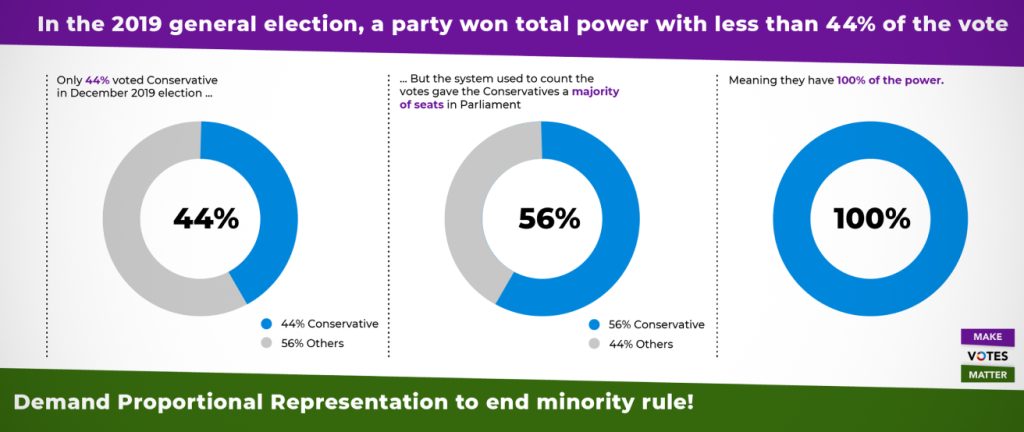
Lord Teverson recalled casting his first vote in 1970, in the constituency of Wanstead and Woodford, and realising afterwards that it counted for nothing, a two-party seat where his preference was never in contention. He drew a direct line from that experience to 2024, when Labour won a landslide majority of 172 seats on just a third of the vote, while 8 million eligible people weren’t even registered and a further 40% of those on the register didn’t turn out. He put it plainly: this Bill is silent on the single biggest reason so many votes simply don’t count.
Lord Pack made the same point with sharper detail. First Past the Post, he argued, was built for a two-party system, but the UK now regularly sees five or six parties competing seriously in the same contest. He flagged specific distortions the Bill leaves untouched: national mailshots that bypass local campaign spending limits entirely, and a threshold for foreign-ownership scrutiny of donor companies that is more generous than the one already applied to newspaper ownership.
Baroness Smith of Llanfaes asked directly why a bill called the Representation of the People Bill has nothing to say about the growing gap between vote share and seat share under First Past the Post, and asked whether the Government had any plans to review the electoral system at all.
Even peers telling stories in the system’s favour ended up making the case against it. Lord Foulkes described being elected to the Scottish Parliament “by mistake” via the regional list, having campaigned barely at all, while a Green MSP on the same list held the seat for four years without a single constituency surgery. He meant it as a warning against changing the system; read the other way, it shows how little a voter’s choice can matter when the mechanics are wrong.
Lord Fuller raised a related complaint: the UK now runs at least six different voting systems and wildly uneven ward sizes, a Birmingham councillor represents roughly three times as many people as a London one. Unfortunately, his suggested fix was consistency via a return to First Past the Post rather than a move to something proportional.
The Minister’s response
Responding for the Government, Baroness Taylor of Stevenage was clear that the Prime Minister is “open to different ways of having a debate” about the voting system and welcomes a national conversation on it but said this Bill is not the vehicle for that conversation, and that a path forward would be “set out in due course.” Several peers, including Baroness Lister of Burtersett, noted that a citizens’ assembly-style commission on electoral reform doesn’t actually require legislation at all, and pressed the Government to say when, not just whether, that conversation will begin.
Why this matters for the case for PR
This Bill will genuinely widen participation: more people registered, younger voters enfranchised, safer campaigning conditions for candidates. Those are real, welcome gains. But as multiple peers pointed out from across the political spectrum, participation and representation are not the same thing. A citizen can be registered, informed and highly motivated to vote, and still have their vote translated into nothing at all if they live in a safe seat under First Past the Post.
The debate also underlined a point Make Votes Matter has long made: donation caps, spending limits and voter ID rules are all important guardrails, but they treat the inputs to elections. They don’t touch the output of the conversion of votes into seats, which is where First Past the Post does its real damage to the link between what people want and who governs them.
The Bill now moves to Committee stage in the Lords, where peers have already signalled a long list of amendments on donation caps, on crypto donations, on the Electoral Commission’s independence, and, for a minority but persistent group of peers, on the voting system itself. Whether the Government’s promised “national conversation” on electoral reform turns into anything concrete remains, for now, an open question and one worth holding them to.