By Lewis Norton, Welsh campaigns volunteer and member of the Young MVM executive.
In recent months, I, alongside other dedicated Make Votes Matter campaigners, took up the fight of encouraging residents in three Welsh councils (Gwynedd, Ceredigion, and Powys) to engage with consultations on replacing First Past the Post (FPTP) for local elections with the Single Transferable Vote (STV). Despite finding ourselves on the wrong side of several close results, there is every reason to believe that the future is bright for Welsh local democracy.
The Welsh context
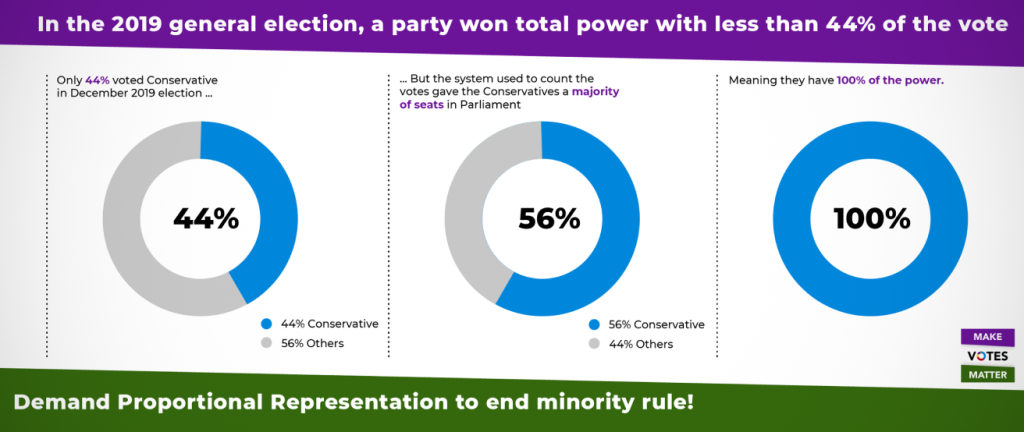
To this point, elections to every local authority in Wales have been decided by FPTP. Characteristically, the system has delivered deeply disproportionate outcomes in Wales. Far be it to simply make the outcomes a poor account of what the electorate voted for, the Welsh local electoral system also has the track record of discarding voters’ ability to choose completely. In 2022, over 100,000 voters were denied the ability to vote in local elections courtesy of uncontested seats, with some of the worst offending councils for their proportion of uncontested seats being the consulting councils of Gwynedd (40.58%), Ceredigion (13.16%), and Powys (10.29%).1
Councils now have the option to switch to STV for their elections2, the system which is already used in Scottish local elections. However, several requirements needed to be fulfilled for this change to happen; the council needed to hold a consultation on the matter3; and the resolution to change the system needed to be passed by two-thirds of the total number of councillors by the 15th November three years before the next local elections4 (which for the 2027 Welsh local elections, set the deadline as this year). Regrettably, most of the 22 councils in Wales opted not to hold a consultation. But in the three councils that chose to do so – Gwynedd, Ceredigion, and Powys – our campaign for change hit the ground.
On the ground
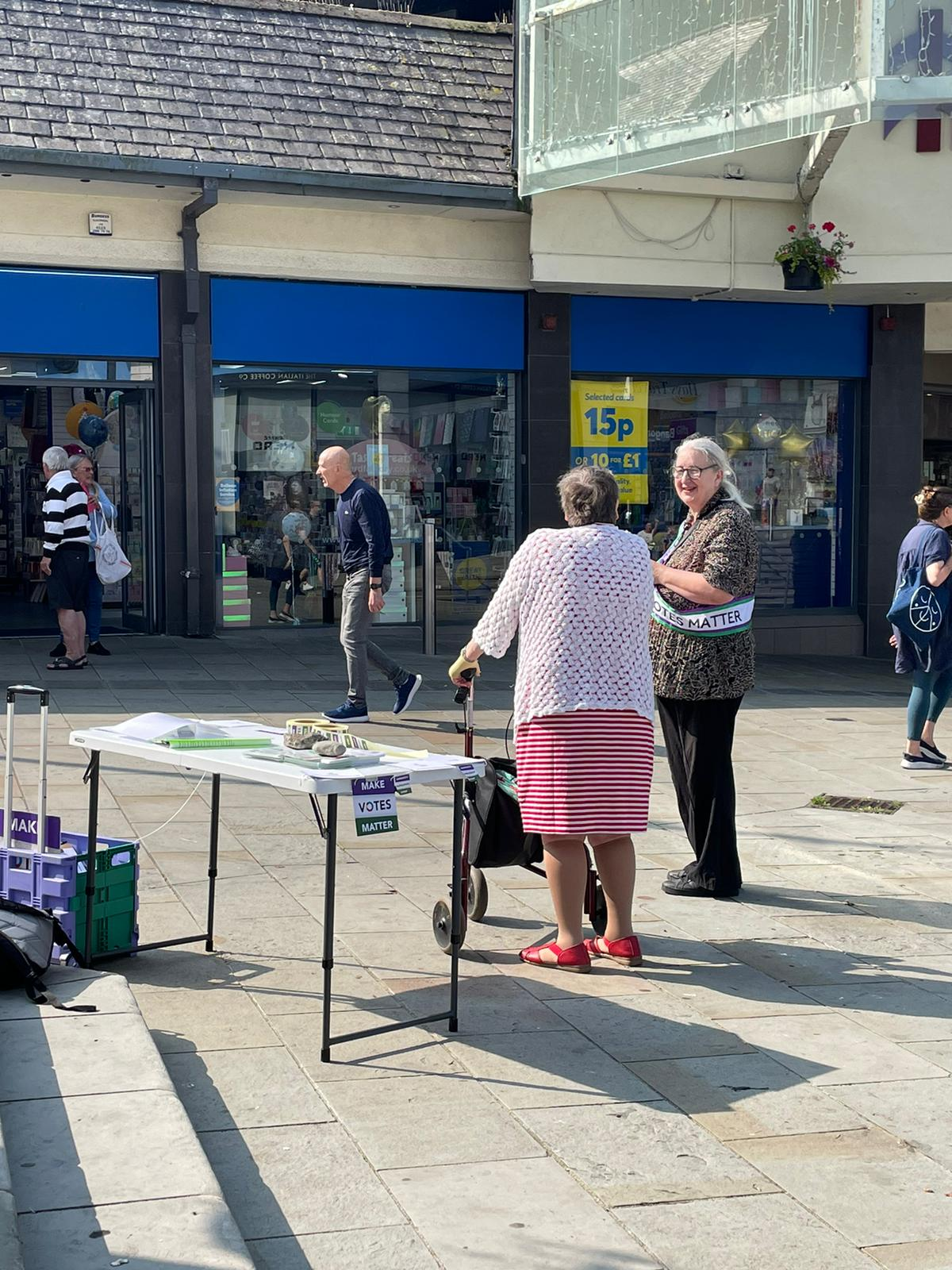
Have you ever filled in a council consultation? I can put my hand up and say I never have (though I definitely look out for them more now). Here laid the biggest obstacle. With even some of the most engaged people often overlooking these consultations, it was imperative to raise awareness and encourage people to submit responses. Over several weekends, we campaigned in each of the three councils spreading the message of local electoral reform.
Over the course of the two weekends I was present, in Bangor and Aberystwyth, the engagement with the public was overwhelmingly positive. Take-up of leaflets exceeded expectations, and a lot of passersby stopped to have a conversation. Many people, especially in Bangor, where the council (Gwynedd) has over 40% of its seats won uncontested1, were shocked to learn about the distorting effect that the current system has on its council make-up. Naturally, people have questions and concerns about big change, but open conversations with a wide range of people definitely showed that the appetite for reform is strong when people are made aware of the pitfalls of FPTP. The campaign for change brought together people from across the political divide: from Plaid Cymru to Conservative, Liberal Democrat to Labour, the desire for a better democracy is not confined to partisan boundaries. What resulted was a strong, cross-party presence, focused on informing residents of the opportunity to deliver meaningful change.
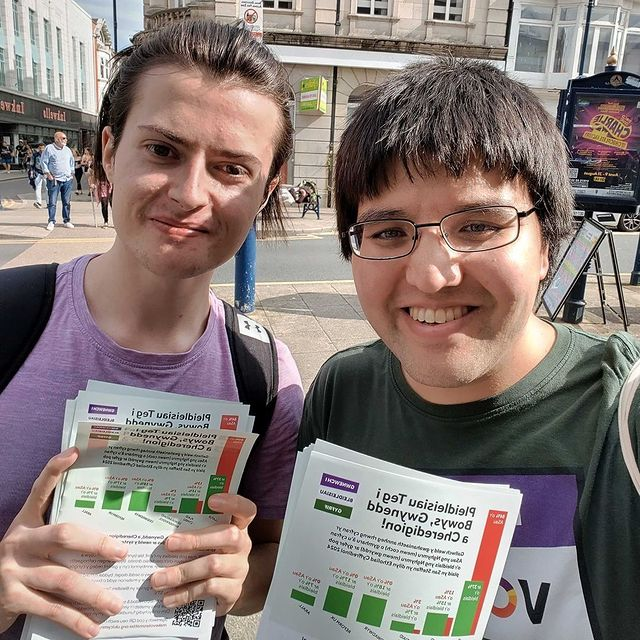
(Aberystwyth) with Cormac Manning (right)
Outcomes
First up was Powys County Council. Public support for change was palpable, with 60.2% of consultation respondents – out of nearly 1300, a comparatively huge tally for such an exercise – declaring STV to be their preferred system. Regrettably, however, when it came to a vote, a majority of councillors – in what will appear to many as an act of wilful self-interest – chose to ignore the clear wishes of local residents and to retain FPTP.
A week later, Cyngor Gwynedd held its vote. Preceded by even more emphatic consultation results (72.2% this time backing STV), councillors voted convincingly in favour of STV, but support failed to reach the two-thirds threshold necessary to trigger the change, falling short by just one vote.
And in Ceredigion, a similar pattern: a clear consultation verdict from the public (67% for STV) – especially remarkable given the questionable wording of the text – and a council vote in favour of change, only to be thwarted by the two-thirds requirement.
So, for the time being at least, Ceredigion, like Gwynedd and Powys, will be stuck with a FPTP voting system that doesn’t have the support of local residents.
2027 and beyond
To have come so close is tough to take. Yet amongst the disappointment, our campaign also offers plenty of positives for the longer-term.
Unfazed by procedural obstacles, residents made their voices heard in loud disapproval of the current system. Councillors in Powys, Gwynedd and Ceredigion know that their voting system does not have the support of their electorate, and two of the three councils officially support change. Even in the narrowest of defeats, what started in Powys, Gwynedd and Ceredigions may well be the beginning of a domino effect.
We can be proud of the difference we made. Yes, there will be no Welsh councils leaving FPTP behind for the 2027 local elections, but there is every reason to believe that more could be open to it in future. These results should give us the encouragement and motivation to continue the fight for a more representative democracy.
- Electoral Reform Society, Elections Cancelled: Over 100,000 Welsh voters to be denied a vote. https://www.electoral-reform.org.uk/elections-cancelled-over-100000-welsh-voters-to-be-denied-a-vote/ ↩︎
- Local Government and Elections (Wales) Act 2021, s.5(1)(b) ↩︎
- Local Government and Elections (Wales) Act 2021, s.8(5) ↩︎
- Local Government and Elections (Wales) Act 2021, s.9 ↩︎