Germany’s federal election on the 23rd of February, 2025, marked a significant shift in the nation’s political landscape, with notable changes in party standings and voter engagement.
Understanding Germany’s Electoral System
Germany operates under a mixed-member system (MMP), designed to balance direct constituency representation with a national parliament that reflects proportional party representation across the country. Each voter casts two ballots:
- First Vote: This vote is for a named party candidate in the voter’s constituency. The candidate with the most votes in each of the 299 constituencies secures a seat in the Bundestag.
- Second Vote: This vote is for a political party. The total percentage of these votes determines the overall proportion of seats each party receives in the Bundestag.
To enter the Bundestag, a party must secure at least 5% of the second votes or win at least three direct constituencies.
2025 Election Outcomes
The 2025 election was a snap election, brought forward due to the collapse of the governing coalition in late 2024. With 630 members elected, he results were as follows:
- Christian Democratic Union/Christian Social Union (CDU/CSU): Led by Friedrich Merz, the CDU/CSU emerged victorious with 28.5% of the vote, translating to 208 seats.
- Alternative for Germany (AfD): The AfD achieved a historic high of 20.8%, securing 152 seats and becoming the second-largest party.
- Social Democratic Party (SPD): The SPD experienced a significant decline, obtaining 16.4% of the vote and 120 seats.
- The Greens: They received 11.6% of the vote, resulting in 85 seats.
- The Left (Die Linke): They garnered 8.8% of the vote and 64 seats.
- Free Democratic Party (FDP): The FDP failed to meet the 5% threshold, receiving only 4.3% of the vote and losing all their seats.
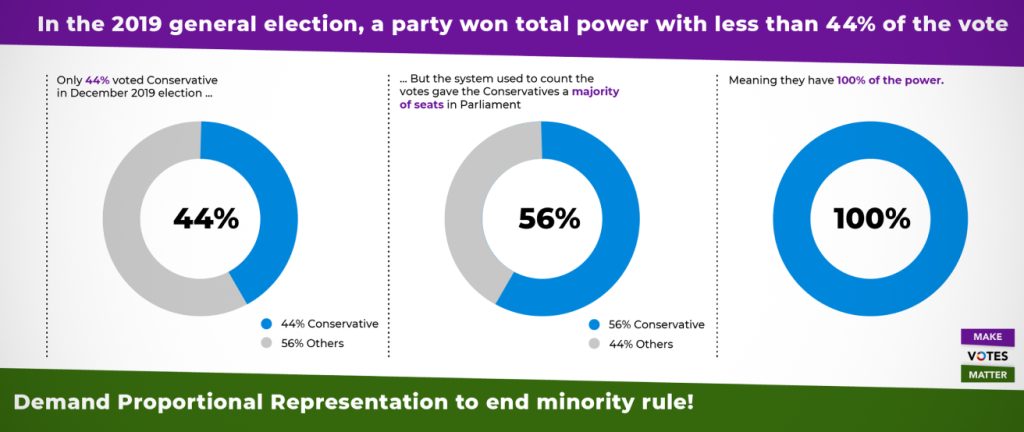
The final result represented a significantly more proportional outcome to the record disproportionality of the British General Election of 2024.
Voter Turnout :
One of the most striking aspects of the 2025 election was the record-high voter turnout of 84%, the highest since reunification.
| Election Year (Germany/UK) | Germany Voter Turnout (%) | UK Voter Turnout (%) |
| 2009 / 2010 | 70.8 | 65.1 |
| 2013 / 2015 | 71.5 | 66.4 |
| 2017 / 2017 | 76.2 | 68.8 |
| 2021 / 2019 | 76.6 | 67.3 |
| 2025 / 2024 | 84.0 | 59.9 |
The contrast between voter engagement with elections in Germany in comparison with the UK is stark. Whilst German turnout numbers have remained much higher than those in the UK over the last 30 years, when covering the five most recent elections in both countries, it’s the nations have diverged in their experiences. While Germany experienced an increase in voter participation, over the period studied the UK has seen a decline, with turnout in 2024 dropping to its lowest level since 2001.
Whilst British voters have become increasingly apathetic towards politics over the past 15 years, German voters are more engaged in the political processes than ever before. This connection shouldn’t surprise us. It’s simple really, if your voice matters, you’re more likely to use it. Across the world, nations using PR see higher levels of turnout than those using FPTP. We need a political system that reflects the diversity of its citizens, we need PR.
Written by Alberto Smith