By Katie Todd, a student at Warwick University, campaigner for LGBTQ+ rights and a Young Make Votes Matter Ambassador
LGBTQ+ History Month is about celebrating the progress of the past and confronting the injustices of the present. Despite decades of activism, there is still a long way to go in eradicating discrimination and ensuring that every LGBTQ+ person feels safe, respected and represented by our politicians.
What is the connection between LGBTQ+ rights and our voting system?
At first glance, it may seem like these two causes are completely separate. However, if we look closer, it turns out that First Past the Post contributes to disenfranchising LGBTQ+ voters. To me, campaigns for a truly representative, democratic politics and for minority rights are closely linked.
As a young queer student, I’ve so far only had a chance to vote in one national election. I posted my ballot excited to have my voice heard for the first time. Afterwards I was left questioning why I felt I had no true choice.Like millions of others, my vote was cast in a safe seat where it felt almost meaningless. I’ve spoken with queer friends who didn’t bother voting. They didn’t want to choose between voting tactically for a party that didn’t feel right for them, or casting a vote that’s effectively wasted.
Like many minorities, LGBTQ+ people find that, under First Past the Post, the maths is against us. We’re a numerical minority in all constituencies and our collective vote is rarely enough to swing elections under a winner-takes-all system. As a result, our voices and demands are often drowned out.
Meanwhile, the main political parties chase a small number of swing voters in key seats. Politicians are often told to avoid “controversial” topics such as LGBTQ+ rights in order not to alienate a specific kind of key voter in selected marginals. Queer people are rarely considered such key voters. As a result, our voices are often dismissed, and many of us lose faith in politics. While a direct causal link would be hard to establish, it’s interesting to note that, out of the 20 constituencies with the highest LGB+ population (according to the latest census), 12 rank in the bottom 22% for voter turnout .
Under First Past the Post, political candidates must fit a narrow definition of electability – because the only candidate who matters is the one with the broadest political coalition behind them. Candidates who challenge conventional views or risk causing controversy often find themselves sidelined, which can be a barrier to progress.
LGBTQ+ identities have historically been categorised as too “niche” and polarising to win. Take Maureen Colquhoun, the UK’s first openly lesbian MP elected in 1974. After her identity was revealed publicly, there was a swift attempt to deselect her by her own party in 1977. The deselection campaign also cited her ‘obsession with trivialities such as women’s rights’. She lost her seat in 1979. It has always been clear: difference is seen as a problem in a winner-takes-all system that prefers lowest-common-denominator candidates.
First Past the Post is a barrier to progress
Since then, thanks to the tireless efforts of many activists, LGB+ representation has improved in politics. However, there is a catch. Whilst having 64 openly LGB+ MPs in Parliament is a step in the right direction, some of the most marginalised voices are still left out entirely.
We’ve still never elected an openly trans or non-binary MP (Jamie Wallis came out as trans in 2022, while already serving as an MP, and stepped down at the next election). As a result, we find ourselves in the absurd situation where questions regarding trans rights and identities are debated in Parliament without their presence. I don’t believe that this is a coincidence in a system which prioritises appealing to the majority over empowering minorities.
Meanwhile, under Proportional Representation, every vote contributes, which means that minority communities can have a greater impact. It doesn’t matter if people who think like you and have the same priorities only constitute 5 or 10% of your constituency – your voice can still be represented, and every vote matters equally.
For example, the world’s first openly trans MP, Anna Grodzka, was elected in 2011 in Poland – a famously conservative country where LGBTQ+ people are fighting hard for acceptance. Thanks to a proportional voting system, a small socially progressive party could win seats, enabling some of the country’s most recognisable LGBTQ+ rights advocates to enter Parliament.
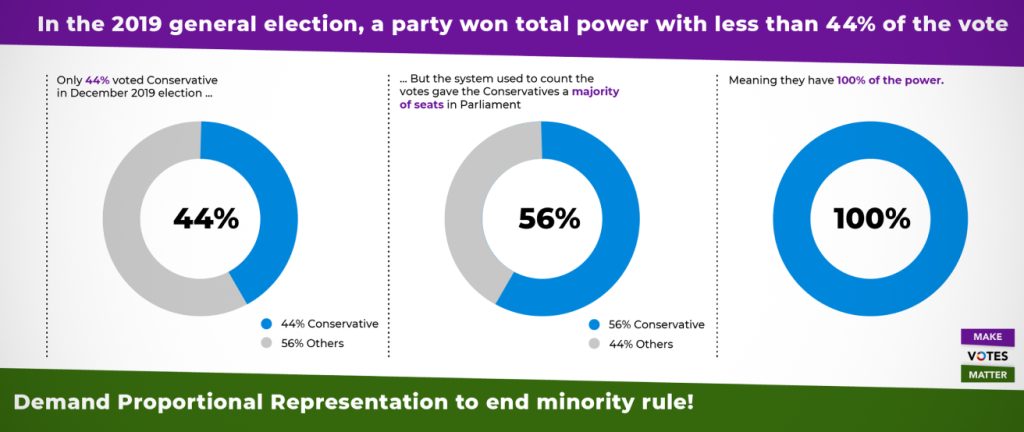
Historically, First Past the Post has had dire consequences for our community. Policies which were widely opposed by LGBTQ+ voters passed through Parliament off the back of large and underserved majorities. Section 28, for example, which was passed under Thatcher in 1988 with her 102-seat majority, which she secured despite only getting 42.2% of the vote. Today, the system which allowed this undemocratic attack on LGBTQ+ rights remains in place.
FPTP is not just unfair, it’s a systemic barrier to full equality. Our political system actively locks the diverse range of queer identities out of politics. LGBTQ+ representation should not be conditional on being electorally palatable to the biggest group of voters. Decisions should not be made without those directly impacted being heard. No one should be forced to tactically vote for what they consider the “lesser evil” or have their voice ignored.
There has been progress. The legalisation of same-sex marriage in 2013 saw LGBTQ+ rights advance through a moment of rare cross-party cooperation. Backing from both Labour and the Conservative-led coalition government showed two important things. Parties are capable of working together to bring change, and coalition governments can and will take decisive and effective action. This should not be the exception. Under a system of PR cooperation is encouraged, coalition building is the norm, and progress is not left to chance.
LGBTQ+ History Month gives us a moment to reflect on the victories we’ve achieved and the work that’s yet to come. The fight for equality is not over, and to win it, we need true political representation that allows all voices to be heard.