By Rose Hensher, an activist with Young Make Votes Matter
This Saturday, Australia will vote. In every neighbourhood, there are signs in front lawns and campaigners on street corners. In pubs, people are talking about who they’re going to vote for over their pints. The suspense is building. I can feel the energy 17,000 kilometres away. I grew up assuming every democratic election felt like that – until 2024.
I moved to the UK from Australia three weeks before last year’s general election. The polling indicated that this election would be historic, with a change of government after fourteen years. I was expecting everyone to be talking about it. Instead, I was shocked by how quiet it was. To most people, election day seemed like a tiresome formality. When I asked my friends how they were feeling about the election, they all had the same response: that their votes didn’t really matter. The only evidence of political energy I saw was in my neighbourhood in north London, where Jeremy Corbyn was re-elected in a campaign of local goodwill and longtime service.
When I try to think of iconic moments in the 2024 election, the only one I can really come up with is a soggy Rishi Sunak announcing the election while a prankster blared ‘Things Can Only Get Better’ through the rain. I can’t remember what Labour’s victory looked like; whether there was a defining TV moment or not, it didn’t stick. I was confused. Given Labour’s massive seat majority, I thought this was a paradigm-shifting result. At home, it would’ve been a massive deal. Here, nobody seemed to care. There were no election-day parties or results post-mortems over drinks at the pub – the world just kept turning.
To explain why this was such a big culture shock, I should tell you what I’m used to. Voting is compulsory in Australia, and our voting system is completely different.
Like you, we have an upper and lower chamber of Parliament – the House of Representatives (lower) and the Senate (upper). To elect our House of Representatives, we use the ‘Alternative Vote’ system, which uses a preference system to award seats to the candidate with a majority of votes. AV voting is more sophisticated than First-Past-the-Post – but it’s not perfect. It still doesn’t guarantee proportionality, and leaves many voters across the country without an elected representative of their choosing. You can read more about how AV voting works and its limitations here.
Unlike in the UK, our second chamber is also fully elected. Our Senate also has significantly more power than the House of Lords does. It holds our government accountable, has the power to block (and not just delay) legislation, and even to force elections when necessary – so how we elect it really matters. Instead of only electing one senator per seat, we elect twelve senators for each state and two for each territory, using a single-transferable vote system. Voters rank candidates from first to last, and candidates need to receive a representative quota of votes to be guaranteed a Senate seat. Once a candidate reaches that quota, their votes are redistributed according to the voters’ preferences, until twelve senators have been elected. This system is fully proportional, ensuring that votes aren’t wasted.
On paper, electoral systems sound boring – but they really matter. They affect everyone; the way a political system is set up fundamentally changes how you are represented and how people engage with politics.
Your vote matters more in a proportional system. In the Australian Senate, the seats a party gains accurately reflects their strength of support from the public.That means that minor parties and independents are much more likely to be elected; no Australian government has had a majority in the Senate since 2007. Put simply, you are much more likely to be represented by someone you actually voted for.
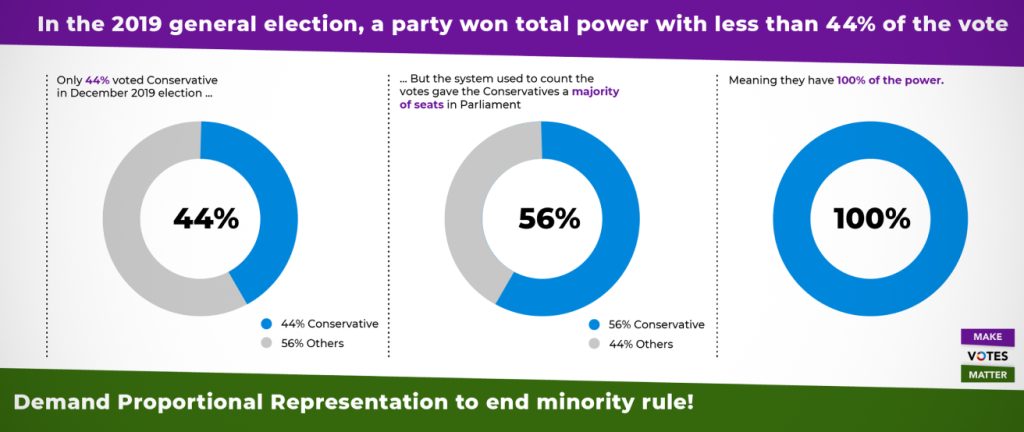
Compare this to the UK, where smaller parties’ victories are stifled, and major parties are rewarded for poor electoral performances. Last year, Labour won its smallest share of the vote in history, and minor parties won massive shares of the vote. Labour ended up with a huge parliamentary majority, and minor parties like Reform and the Greens – despite winning 14.3% and 6.7% of the vote, respectively – ended up with a tiny number of seats. That’s not fair, nor is it democratic.
Australian major parties have to work with minor parties and independents much more. In the UK minor parties rarely win seats in the first place, and when they do, they can’t hold governments accountable, even if they do command public support. The major parties often have large parliamentary majorities, which they use to unilaterally pass legislation. This is bad for democracy. Labour only won 34% of the vote, in an election where less than 60% of the country voted. Their mandate is shaky; but in a first-past-the-post system, they can do what they want without consulting other parties.
In Australia, if a government doesn’t command the backing of a majority of the public it needs to reach out to other parties to find a consensus. This means that when legislation is passed, it’s more representative of the public’s views and therefore more robust. In a proportional system, your elected representative can have a real impact on government policy, regardless of their party affiliation.
When I moved, I was confused. Over time, I stopped being confused and started to understand why people were disillusioned. Last year’s election – the most disproportionate in recent history – was a manifestation of Britain’s first past the post system. British people weren’t disengaged; they were fed up. They didn’t think their votes mattered. Why would they? They had lost faith and interest in the system.
This is why proportional representation is important. I’ve seen how elections work in systems with proportional representation and without it. People are more engaged in politics when they are well represented. Engagement is important; it’s how we ensure a functional democracy – and it starts with elections that people care about. People only care about elections when they think that their vote really matters. I’m excited about Australia’s election. British people deserve to be excited about their elections, too.