It’s been over 100 years since some women got the vote. In recognition of International Women’s Day 2026, Make Votes Matter hears from activists representing three generations of women on how our voting system affects them and why they support and campaign for Proportional Representation.
Whilst much has changed in society, when it comes to systems in Westminster, little has shifted. Whilst we remember the women before us who fought seemingly impossible battles, and celebrate those shaping politics today, we must remember how much there remains to be done.
Studies consistently show that First Past the Post is the worst electoral system for women’s representation. Meanwhile, countries that use Proportional Representation tend to have more gender-balanced parliaments that better reflect the views of all sections of society.
Let’s make sure women’s voices are heard in debates about the future of our democracy.
The 1918 Representation of the People Act gave some women the vote for the first time.The subsequent one in 1928 equalised voting rights between men and women. May the 2026 Representation of the People Bill – going through Westminster right now – make our votes truly count.
For International Women’s Day 2026, we spoke to three brilliant women representing three generations of campaigners about why a fair voting system is a feminist issue. Scroll down to read what they had to say!
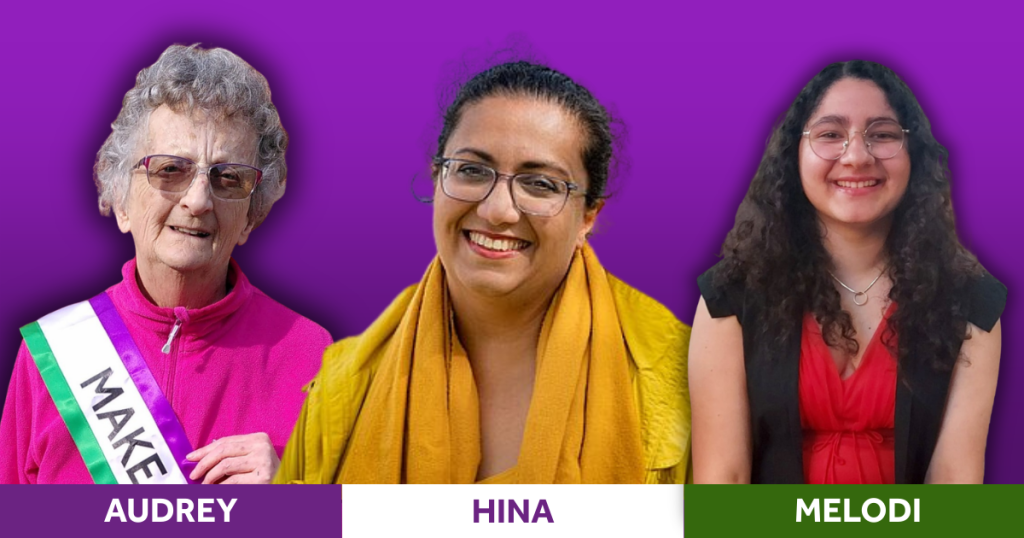
Audrey is a volunteer with York and North Yorkshire Make Votes Matter:
I have spent a lifetime fighting for fair representation. As a woman who has lived through decades, and has seen change and progress for women, I know the voting system still isn’t representative and this is holding women back.
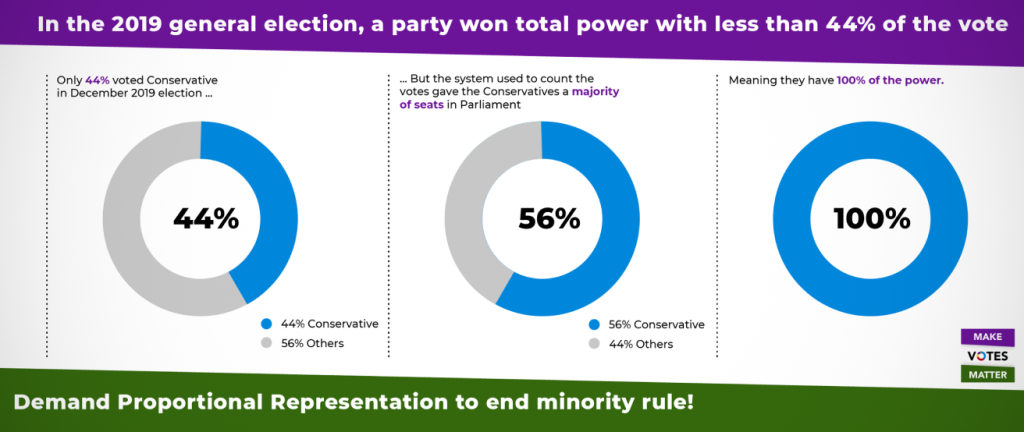
More than 100 years on from women winning the vote nothing much has changed with democracy. We still use an antiquated system that means millions (like myself) have never been able to cast a vote and have it count towards the make-up of Westminster. In some general elections over the last 20 years, up to 70% of votes have been considered wasted i.e. did not contribute to the make up of Westminster. We have even had two elections in the last 100 years where a party won the most seats despite getting fewer votes!
Having a Parliament which isn’t representative of how people are voting does a disservice to the Suffragists and Suffragettes who sacrificed so much to give us the vote. I hope I will see a day when these women who went before us can be remembered with a voting system that carries on the work they started!
Hina Bokhari OBE is a Member of the London Assembly:
This International Women’s Day, I want to focus on something that can sound technical but is absolutely fundamental to women’s representation in politics: our voting system.
As a Liberal Democrat, I’ve always been a supporter of Proportional Representation. It’s one of the things that really unites our party because it gets to the heart of who actually gets to have a say in our democracy.
I’m lucky because I’m one of the few politicians who actually gets to see how a PR system works every single day. I was elected to the London Assembly as the first ever Muslim woman under a form of PR, and the benefits of such a system could not be clearer to me.
Take, for example, the fact that today 44% of Assembly Members are women – a massive step up from what you see in Westminster. And it’s not by accident either. Under the “First Past the Post” system we use for MPs, millions of votes just don’t count for anything.
Because of that, political parties tend to end up focusing all their money and energy on a tiny number of swing seats, and when they pick candidates for those seats, they almost always play it safe. They go for the “traditional” choice, and that usually means women and people from underrepresented groups get sidelined before the race has even started.
Proportional representation flips those incentives. When every single vote counts equally, parties can’t just ignore huge chunks of the country. They have to appeal to everyone, which means they have to put forward a team of candidates that actually looks like the public. It helps open doors that have been slammed shut for years.
But this isn’t just about who gets a seat, it’s about what happens once we’re actually in the room. At City Hall, we have five parties represented by 25 Assembly Members. No single party can just steamroll everyone else. If you want to get anything done, you have to talk to people from other parties. You have to negotiate, persuade, and build a consensus. As Liberal Democrats, we’ve worked with the Conservatives to get a Disability Champion for London, with Labour to tackle Islamophobia, and with the Greens to protect trans rights.
This kind of politics, where you actually collaborate instead of just shouting at each other across a room, is far more effective. It leads to policies that actually last because they’re built on common ground rather than being forced through by whoever is loudest that day. This style of working is exactly what we need more of, especially for women who often find the aggressive Punch and Judy atmosphere in Parliament so unappealing.
Don’t get me wrong – we still have some pretty robust clashes at City Hall. Sometimes I feel infuriated when I see injustice or bad policy, and anyone who’s watched me in the chamber knows I don’t hold back when it matters. But the difference is that even after those heated debates, we can still sit down together and find solutions. That’s what a better voting system makes possible.
So this International Women’s Day, I’m celebrating what PR has achieved at City Hall. But I’m also calling on Westminster to catch up. Women deserve a democracy where every vote counts, where our voices aren’t drowned out by an outdated system, and where politics is about collaboration rather than combat. The evidence is right here in London. Proportional representation works. It’s time to make it the norm, not the exception.
Melodi is a university student and campaigner with Young Make Votes Matter:
I have lived in the UK for 6 years and can only now begin applying for my citizenship and right to vote. I have been part of British society and I’m subject to British laws – for example tuition fees – but so far have been locked out of voting. But even when I do get my vote, it’s unlikely to count towards the make-up of Westminster because of the seat I currently live in.
On International Women’s Day, it is so important that we hear from women of all backgrounds on issues that shape our lives. For me, I don’t feel like we have democratic representation under First Past the Post, in which so many of us are locked out of power by a system that does little to redress decades of gender imbalance.
Almost 100 years since women first got the vote, FPTP is still holding us back. Studies show a link between voting systems and women’s representation, and the handful of countries with at least 50% representation of women in their primary chamber all use PR. It’s time we started getting to the root of our democracy issues and fixed the broken voting system at the base of it!