Make Votes Matter statement for immediate release
Contact: Steve Gilmore, Media Manager: media@makevotesmatter.org.uk / 07948 219975
Wednesday 30th October 2024
Stability will be short-lived while First Past the Post remains
Campaigners highlight the UK’s increasingly volatile electoral system as a source of uncertainty
Statement from Emma Harrison, CEO of Make Votes Matter, reacting to the Budget:
“Today’s Budget commits the country to yet another new strategy for economic growth, but while some nations are able to build for the long term, our unpredictable voting system bakes in instability.
“The test of this Budget will be if it can instil confidence. But confidence demands stability. And the evidence shows that countries with majoritarian voting systems like ours, where minority rule is the norm, are more prone to instability.
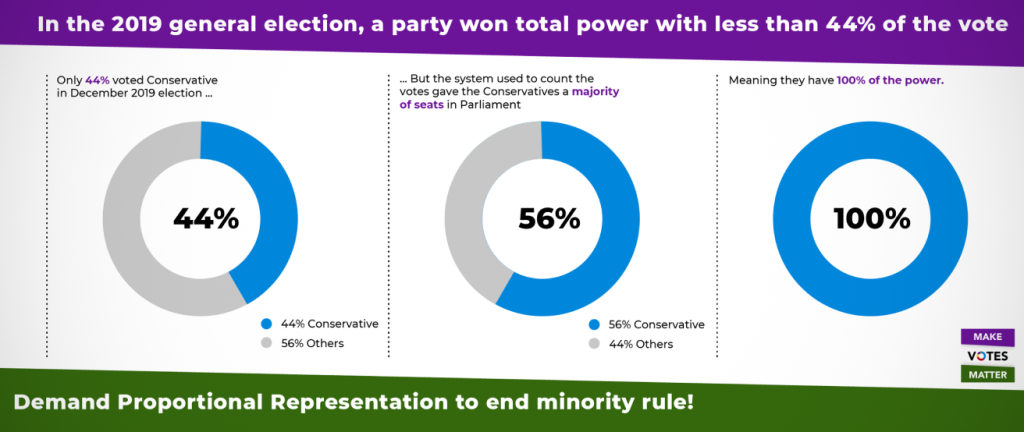
“It’s commonly accepted that any strategy for growth will require both time and investment. But because governments in our system can wield all the power on as little as a third of the vote, with little incentive to secure the support of a wide range of stakeholders, we can often move from one track to the next at dizzying speed, giving too little time for any plan to properly bear fruit, and disincentivising long-term investment.
“These frequent, often quite drastic changes in policy direction risk wasting both time and money. Just look at the political hokey cokey over HS2, reprised again today, or the decades-long failure to craft a sustainable settlement for social care.
“Paul Johnson of the IfS recently observed that under a different electoral system, where decisions around economic strategy require broader support, plans can hold for longer, in turn reducing uncertainty and increasing confidence.”1
“At this critical juncture, Britain needs a voting system we can rely on – one that combines proportionality, accountability, and stability. First Past the Post fails on all these counts. Instead of fostering consensus and stability, it enables minority rule, stokes division, and breeds economic uncertainty.
“If we want to see change that lasts, we need a political system that allows us to plan for the long term.”
-ENDS-
Notes to editors
1 Paul Johnson, Director of the Institute for Fiscal Studies, speaking at an Intelligence Squared event, October 2024: “I think there’s at least some evidence that a better designed electoral system has an effect on the quality of economic policy-making, where you have to take more people along with you so that you don’t chuck everything up in the air and change it every five minutes, which happens both within parties and between parties here, and happens much less in some other countries which have different sorts of electoral politics.” https://youtu.be/Sr5IpVRvhMA?t=4383&si=j86ZK-rTGzxE5aAA
Sources
Alfano, M.R. and Baraldi, A.L., 2014. Electoral Systems and Economic Growth: What is the Importance of the Proportionality Degree? (No. 06/2014). EERI Research Paper Series. https://www.econstor.eu/bitstream/10419/142669/1/EERI_RP_2014_06.pdf
Difford, D. 2024. Strong and Stable: A comparative analysis of the impact of different voting systems on political stability. London, Make Votes Matter. https://makevotesmatter.org.uk/wp-content/uploads/2024/04/Stability-Report-PUBLISH.pdf
Lijphart, A. 1999. Patterns of Democracy: Government Forms and Performance in Thirty-Six Countries. New Haven & London, Yale UP.
Rodrik, D. 1991. Policy uncertainty and private investment in developing countries. Journal of Development Economics, 36 (2): 229–242.