By Make Votes Matter CEO Emma Harrison.

Seven by-elections since 2024 have produced seven different pairs of parties at the top. Not once has it been Labour against the Conservatives. Britain votes like a multi-party country but it still counts votes as if it were a two-party one.
That mismatch is why the Prime Minister’s pledge to put electoral reform in Labour’s next manifesto matters. Alan Renwick of UCL’s Constitution Unit set out the state of play in the Financial Times last week. His piece is fair-minded, and it lists the hurdles reform will face. Let’s unpick them together.
“Labour MPs will go cold if the polls pick up”
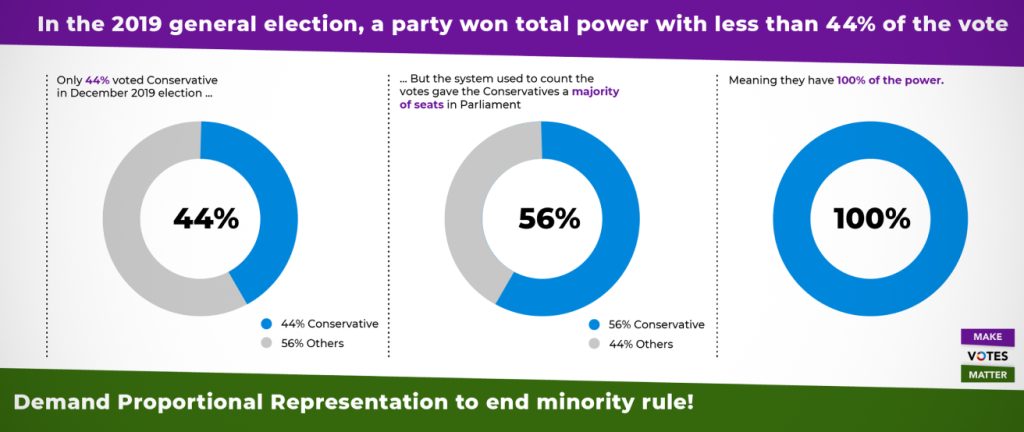
First-past-the-post rewards the biggest party. Labour knows that well: in 2024 it took about 63% of seats on roughly 34% of the vote. So why give that up?
Because the same arithmetic can flip overnight. In a five-party race, a party in the low 30s can win a landslide. That party need not be Labour. The system that handed Labour a supermajority could hand one to, say, Reform on an even smaller share.
A good poll this autumn is not a safety net. Holborn and St Pancras has just shown the Greens can take Labour on in its own heartlands. Many MPs sit on majorities that a modest swing in a five-way race could erase.
“Voters don’t care about it”
Few people rank “the voting system” as a top issue. Few rank “the plumbing” either, until the house floods. What voters do care about is the result: a vote that counts and a Parliament that looks like the country.
Millions already work around the system. They vote tactically, hold their nose for a second choice, or stay home in a safe seat. Each by-election this term has asked voters to guess which two parties are really in the race. That is a symptom of the problem, not proof it doesn’t matter.
Electoral reform doesn’t have to be the main topic of every electoral campaign, speech and manifesto. It has to be in there, explained in terms of what people already feel: fairness, and an end to wasted votes.
“The public already said no in 2011”
They did, by about two to one, on a turnout of around 42%. But look at what they were asked. The alternative vote was a compromise that even many reformers didn’t want. It was put to a referendum mid-coalition, when the party proposing it was deeply unpopular.
The country has changed since then. In 2011 Labour and the Conservatives still dominated. Today five parties win serious votes and none comes close to half. A referendum on AV in a two-party era tells us little about a proportional system in a five-party one.
One vote fifteen years ago does not settle a question forever. Nobody argues that 2011 settled anything else about British politics.
“Settle for the supplementary vote or AV”
This is the most tempting trap, because it looks like progress. Ranking candidates would end some tactical voting. But as Renwick himself notes, SV and AV keep 650 separate winner-takes-all contests. Seats would still bear no reliable relation to votes.
The Prime Minister has named two goals: ranked preferences and proportionality. A half-measure delivers one and drops the other. It would also burn the political capital needed for real change, then let opponents call the job done.
The options that meet both goals are well tested:
- Single transferable vote. Already used in Northern Ireland and in Scottish council elections, and for Ireland’s parliament for a century.
- AV+. The Jenkins Commission’s 1998 design, keeping a local MP for most seats with top-up members to balance the result.
Either would be a genuine change – and both are forms of PR. A preferential system with no proportionality would not.
“Coalitions mean instability and weak accountability”
Single-party majorities are not the same as stable governments. Britain got through seven prime ministers in the last decade, all elected under first-past-the-post.
Much of northern Europe is governed by coalitions. Germany, the Netherlands and the Nordic countries are hardly bywords for chaos. Scotland and Wales have run devolved governments under proportional systems for over 25 years.
Accountability under the current system is thinner than it looks. A government elected by a third of voters can push through anything with a whipped majority. Under a proportional system, a government needs parties representing most voters to agree. That is a stronger mandate, not a weaker one.
And in a five-party Britain, coalitions or minority governments may come anyway. The real choice is whether they reflect how people voted.
The window is open now
Alan Renwick is right that nothing is inevitable. He judges change likeliest if no party wins outright at the next election. That is exactly why the commitment must be firm and specific before then.
We should ask three things of the Prime Minister’s review:
- A clear timeframe to be announced as a matter of priority, along with a commitment that the Commission’s findings will be published ahead of the next general election.
- That it’s genuinely cross-party, helping build consensus and avoid accusations of a Labour “stitch-up”.
- Meaningful public engagement, with voters’ forums/citizens’ assemblies held across the country.
Seven by-elections have shown what kind of country Britain now is. It’s time our elections caught up.