By Make Votes Matter CEO Emma Harrison.
Like a lot of people who campaign for fair votes, I’ve never been all that interested in the mechanism for its own sake. It’s rare to find someone who grew up dreaming about D’Hondt formulas or STV ballots. What I care about is what a fairer, more proportional system can actually deliver for people, for communities, for the country.
I started caring about this as a teenager in rural Lincolnshire, watching an election result come in that I knew, before a single vote was counted, would never reflect what many of my neighbours and I actually thought. Under First Past the Post, my vote didn’t count for anything. Not because I didn’t turn out, not because I didn’t care, but because the system had already decided my constituency’s outcome long before polling day.
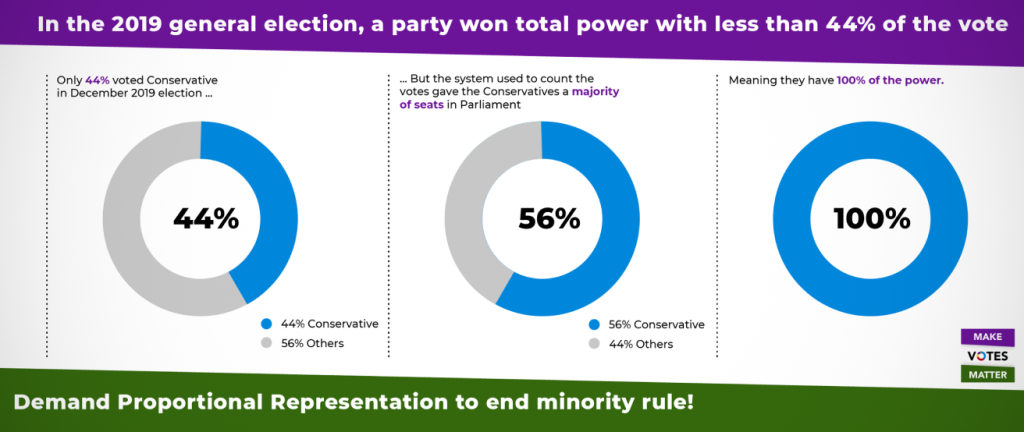
But the deeper problem isn’t just that individual votes get wasted. It’s what First Past the Post rewards. A system built on safe seats and narrow swing-vote targeting doesn’t reward the hard work of building consensus. It rewards division. It rewards telling one part of the country that another part is the enemy. It rewards anger, because anger turns out, not persuasion. That is the opposite of the country I want to live in.
The “too hard” box
I’ve spent my career working in charities and public policy, and the same pattern keeps showing up. The issues that matter most to people’s lives – social care is the one I’ve come back to again and again – don’t get solved. They get kicked down the road. They land in the “too hard” box.
That’s not really a coincidence. Fixing social care properly requires the kind of politics First Past the Post actively discourages: long-term thinking that outlasts a single Parliament, collaboration across parties who’d rather score points off each other, and sustained public consent for a plan that will take years to pay off. A system that manufactures artificial majorities and treats every issue as a five-year electoral weapon is structurally incapable of that kind of governing. It’s not that our politicians lack the will. It’s that the system they’re operating in punishes them for trying.
We’re watching that play out again right now. The Prime Minister has thrown down a genuine challenge to the other parties: work with us on fixing social care. The Liberal Democrats have said yes. The Conservatives’ answer amounted to yes, but not if it means raising taxes or borrowing to pay for it, which is another way of saying no. That’s the pattern. Under our current system, “no” is always the easier, safer, more electorally rewarding answer than “yes.” A politics that punished obstruction as much as it rewards it would look very different.
That’s why, when Compass asked us to join Better!, we said yes without any hesitation.
Why Better!
Better! starts from a simple, and I think obviously true, idea: you can’t fix Britain’s biggest problems without first fixing the systems that decide who has power, whose voices get heard, and whose interests our politics actually serves. That means campaigning together, alongside a coalition of organisations across the country, for three things:
- A fair voting system, so every vote counts equally, wherever you live.
- A fair tax system, so wealth works for everyone, not just the few.
- A fair media landscape, so information serves the public interest rather than a handful of owners.
These aren’t three separate campaigns that happen to be sharing a launch date. They’re three parts of the same broken operating system, and that’s exactly why a coalition like this makes sense. Fair votes without a media environment capable of informing that vote honestly is a hollow win. And I say that as someone who has worked in and around the media throughout my career, I can tell you with some confidence: the media needs fixing too.
What collaborative politics actually gets us
This is where I come back to what got me into this campaign in the first place. Fair votes matter to me because of what they unlock, not because proportionality is elegant. A voting system where every vote counts is a voting system that has to build coalitions, has to negotiate, and has to answer to the whole country rather than a few thousand people in a few dozen constituencies. That’s the kind of politics that can actually take on something like social care – because it’s the kind of politics built for patience, cooperation, and long-term commitments that survive a change of government.
Better! gives us the chance to make that case alongside people fighting for fairer taxes and a fairer media, because none of us are going to win our fight alone. The systems are connected. So the campaigns have to be too.
We’re proud to stand with Better!, and we’d love for you to join us.