By Ana Oppenheim, Communications Manager at Make Votes Matter.

“You’re joking – not another one!”
Those were the famous words of Brenda from Bristol who was vox popped by the BBC following Theresa May’s snap election announcement in 2017. I can’t help but hear the viral clip in my head every time it’s Prime Minister resignation day – a moveable feast which seems to come around quicker every year.
Little did we know back then that there would be many more “another ones”. Since 2016, we’ve had six Prime Ministers resign, each apparently determined to beat the previous one’s record of unpopularity.
Commentators across the national and international media have been trying for years to answer the question: what makes the UK so impossible to govern? Some blame Brexit, others point to our stagnating economy. However, there is another, often overlooked quirk of our politics that contributes to the instability we’ve seen over the past decade: the First Past the Post voting system.
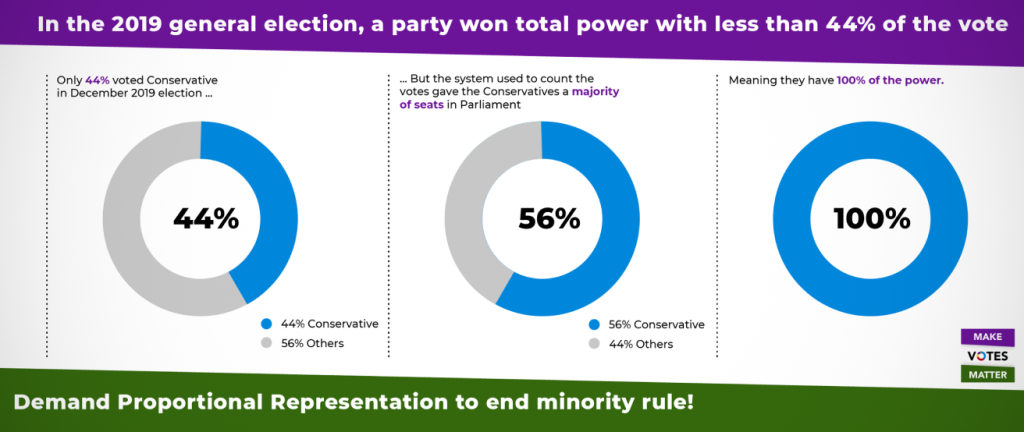
The most common argument against electoral reform, which we somehow still keep hearing in Westminster, is that First Past the Post leads to stable and effective governments. The logic is simple: by delivering disproportionate majorities to the winning party, it’s supposed to allow it to pass laws effectively, without negotiations and delays. It’s also meant to guarantee that governments serve the full term, giving the public a sense of security and the ability to plan ahead.
However, anyone who has paid the slightest attention to British politics in recent years can see that this theory doesn’t match reality. The last stable government we’ve had was the 2010 Conservative-Lib Dem coalition. Winning landslide majorities (without getting a majority of the public vote) didn’t prevent Boris Johnson or Keir Starmer’s governments from collapsing. In terms of policy, we’ve seen U-turn after U-turn, projects started and scrapped, and decisions made with the next (snap) election rather than the next generation in mind.
Coalitions can be messy. Bringing together different voices around the table requires time and the ability to compromise. But, as Britain’s recent experience illustrates, single-party governments can lead to even more chaos. The problems with our politics run deeper than just whoever is in Number 10. Without collaboration and dialogue with other parties, governments fail to carry the country with them. Without a strong mandate from the public, any Prime Minister would struggle to deliver the change that the country has been crying out for.
There is a reason why recent years have been particularly turbulent. Increasingly, British voters are moving away from just voting for the two traditional parties, and demanding more choice. We’re tired of reducing our political opinions to binary options. The British public is no less politically diverse than voters in Germany, Finland or Spain – but the peculiarities of our voting system prevent our full and nuanced range of views from being accurately represented. As smaller and newer parties gain support, First Past the Post is creaking at the seams.
The country is ready for change. The British Social Attitudes survey has found that, consistently since 2021, a majority of the UK public supported switching to a more proportional system. Meanwhile, a report by the Electoral Commission, published just last month, found that 51% of people believed that serious structural changes were needed to our political system. Only 16% said no change was needed.
Westminster is also warming up to the idea of changing how its elected. Alex Sobel’s amendment to the Representation of the People Bill, calling for a National Commission on Electoral Reform, is currently signed by 150 MPs and counting. This makes it by far the most-backed amendment to the Bill, and among the biggest in this Parliament.
The incoming Prime Minister has an opportunity to do something that’s both popular and more urgent than ever. Something that would cement his (we all know who it’s likely to be!) legacy as the one who stopped the chaos and transformed British politics for good.
Last year, at a pro-PR fringe at Labour Party Conference, Andy Burnham said:
“It is dangerous to continue with an electoral system that can elect a majority government on a minority of the vote. So I’m here tonight to endorse the call… for a National Commission to be set up in this Parliament.”
This work needs to happen now – within the first 100 days of his likely premiership. For too long, we’ve been told that electoral reform was not an immediate priority. Now, it’s clear we’ve waited more than long enough. If the last general election was already the most disproportionate one in our history, the next one could make our democracy look like a hollow imitation. There is no time to waste: it’s time to get the Commission underway and design a voting system that’s fit for 21st century Britain.