Written by Reuben Bance, youth campaigner and researcher.
When was the last time you saw politicians from every major party in a room together, laying aside their political differences and engaging in a collaborative discussion?
Over the last few months, Young Make Votes Matter have been teaming up with the London Assembly to tackle one of the key issues facing UK politics today: how to build a politics that engages young people. The London Assembly is elected using Proportional Representation. As such, we thought it could make a great case study showing the kind of cooperative political culture that is possible under a fairer voting system.
During this time, the government’s announcement to extend the franchise to 16-17-year-olds at the next General Election made our work all the more pressing – if more young people are being given the right to vote, it is crucial that politicians, parties, and educators make engaging young people in politics a priority.
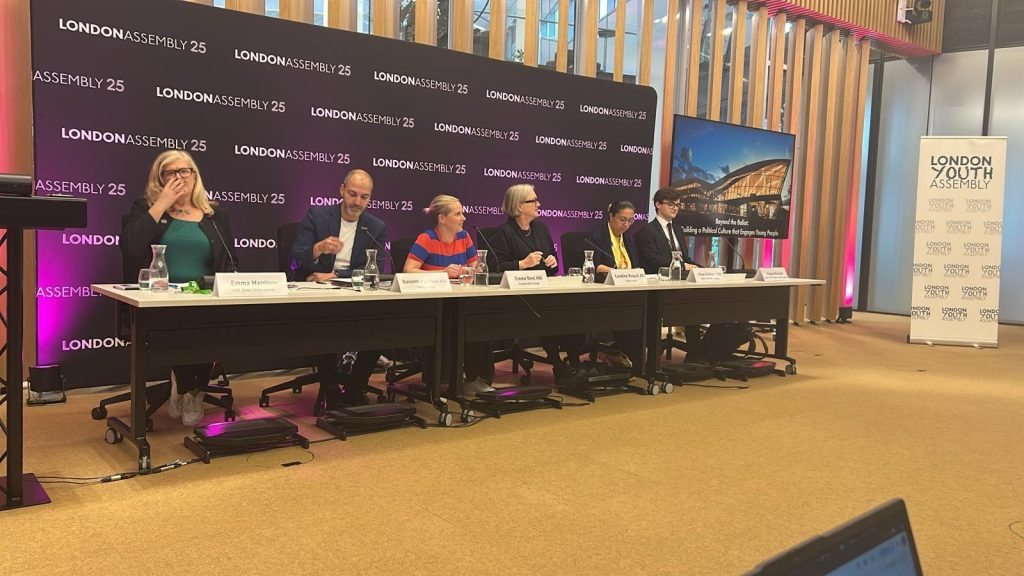
This collaboration culminated on the 14th of October, when Assembly Members representing the five major parties in the UK – Green, Labour, Liberal Democrat, Conservative, and Reform – came together with Young Make Votes Matter at a landmark event at London’s City Hall, to focus on a future that places young people at the center of our political culture.
A common theme across the event was that politicians shouldn’t blame young people for being disillusioned with politics, and instead address the reasons why so many of us are not feeling listened to. As Hina Bokhari, Assembly Member for the Liberal Democrats, noted:
“As a mother of two young children, a 12-year-old and a 14-year-old, they’re just as interested [in politics as everyone else]. They are just as engaged. But it’s not easy for young people these days to really get heard. And I believe that is why we need to change the electoral system. They’re turned off by the fact that, you know, what’s the point in voting if my voice doesn’t get heard? What’s the point of voting if my vote doesn’t matter? We really need to make the change right now to make sure that every voice does get heard.”
Emma Best, Assembly Member for the Conservatives, made it clear that political parties need to step up for young people:
“What’s really important is that every political party listens to the young people who are members and makes sure that they have real opportunities to get involved and to lead things, so that they can actually have some influence on what that party’s doing.” … “We do have a voting system that does not encourage people to be involved.”
London Assembly Members are elected by a proportional voting system, leading to the voices of Londoners being better represented in discussions on the issues facing the capital. This system encourages Assembly Members to work together, across the political spectrum, in order to deliver solutions that benefit the diverse needs of one of the biggest cities in the world.
The difference between the collaborative atmosphere of the Assembly and the often oppositional politics of the House of Commons is clear, and a big part of that is down to how politicians get into government in the first place, As Caroline Russell, Assembly Member for the Greens, put it:
“First Past The Post forces people into binary choices between ‘vote this so you don’t get that’ and that is such a negative way of making decisions.”
Questions to the panel from young people in the audience covered a wide range of issues, but the prevalence of misinformation and abuse on social media was a common theme. One audience member asked for advice on how to deal with narratives online that young people are too “inexperienced” or “naive” for politics. Bassam Mahfouz AM (Labour) offered a positive observation from his own experience: social media allows people to “hide behind” their comments, but out in the real world, the majority are much more accepting, positive, and kind, whether that’s on the doorstep or at the picket line.
Although the evening focused on plenty of difficult questions, a positive look to the future brought the event to a close, focused on the question: what makes you optimistic about the prospect of engaging younger people in politics?
For Alex Wilson AM (Reform), “the most encouraging thing that will happen as a result of more young people getting more engaged and more involved in politics is that there will be ever stronger pressure to actually solve the housing crisis.” Hugo Maxwell, Chair of the London Youth Assembly, stressed that “engaging with young people isn’t a chore for politicians, it’s an opportunity.” For Hina Bokhari AM, young people “can give us all hope for the future.”
What last week’s event at City Hall showed us all is that building a politics on a foundation where every vote matters, where dialogue is prioritised over hostility, and where a diversity of opinion is seen as a strength rather than a weakness, will go a long way in proving to young people that they can have a say in the political life of this country.