
This blog is by Make Votes Matter activist Cormac Manning and reflects his own views.
I recently moved from Britain to America. It’s been an interesting time to do that, to put it mildly.
There’s so much different here, yet I can’t help but be struck by a scary parallel. Whatever side of the Atlantic you’re on, my warning is this: do not let your political system give all the political power to one person, faction, or party.
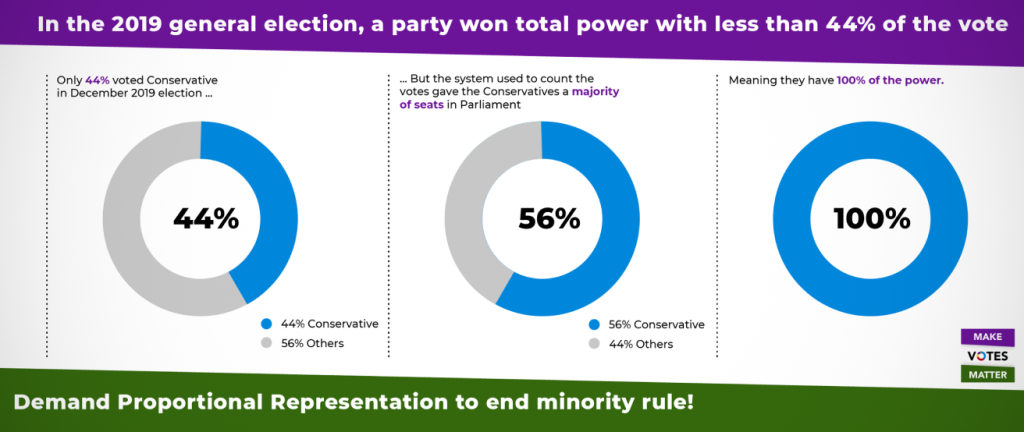
Washington and Westminster have a special relationship when it comes to elections. Unlike almost every OECD country, the UK and the US still use outdated winner-takes-all voting systems which concentrate power in one party and its leader.
This happens even when only a minority of voters choose that party: Donald Trump became President the first time with just 46% of the vote, and Keir Starmer won a “landslide” even though only 34% of people voted Labour. And with British politics diversifying further, the next UK Prime Minister could easily take power on a vote share percentage in the 20s.
Years ago, politicians who liked First Past the Post used to claim that it was needed to keep out extremists. They’ve mysteriously gone quiet on that line recently, so it’s worth taking a cold hard look at the actual facts.
When autocrats and democratic backsliders come to power, they often reduce the proportionality of the voting system.
Viktor Orbán stripped away proportional elements of the Hungarian voting system, taking it a step closer to First Past the Post. Former Mexican leader Andrés Manuel López Obrador tried to abolish Proportional Representation altogether, but he was stopped by mass protests.
And the only country in Europe to have gone the full hog and joined the UK in adopting pure First Past the Post is arguably the least democratic country on the continent: Belarus. That’s right, the only other country in all of Europe to use First Past the Post is the one which has a bank holiday to celebrate the October Revolution.
Westminster knows all this when they’re examining anyone other than themselves. A Conservative government abolished First Past the Post for Northern Ireland local council elections in the 1970s. A Labour government extended Proportional Representation to parliaments in Scotland and Wales, and proudly signed the Good Friday Agreement, which enshrined Proportional Representation as one element in breaking down sectarian divides in Northern Ireland.
Most notably, after the Allies won the Second World War, it was a national security essential that Germany have a stable political system that would not facilitate extremists. So did the Allies impose First Past the Post? No! They facilitated a successful Proportional Representation system that made Germany one of the most stable countries in Europe.
British leaders look aghast at moves by autocrats abroad to consolidate power and reduce proportionality. But that analysis seems to magically disappear when their thoughts return back home. It’s almost as if there’s a sense that we are special, that whatever problems might arise elsewhere, they can’t possibly happen here.
But that’s exactly what the Americans used to think too.
And ominously, what happens in the US today is often a sign of things to come in the UK. While the US voting system is already pretty disproportional, the White House and Donald Trump’s Republican Party are leading a major push to make it even more disproportional by gerrymandering constituency boundaries. The opposition Democratic Party has responded by aggressively gerrymandering in states that it controls. The purpose of gerrymandering is to give a party more seats than votes – the very definition of disproportionality.
While that’s a toxic spiral for American democracy, let’s not sit smug. UK constituency boundaries are currently set by independent commissions, without undue interference from politicians. But those commissions are established by an Act of Parliament. If a radical Government wanted to abolish them and gerrymander all the boundaries themselves, all it would take is an ordinary act of Parliament, passed by MPs representing 34% (or less!) of the public’s votes.
There’s a clear solution to the American gerrymandering wars: Proportional Representation. Drawing constituency boundaries is only powerful if you’re able to change the value of someone’s vote depending on where they live. But in a system where everyone’s vote counts equally regardless of postcode, gerrymandering loses most of its power. That’s Proportional Representation.
In other words, if all constituencies represent both the majority and the minority fairly, then it’s harder to radically change the results by changing the lines.
It’s all so confusing for politicians drunk on the power of First Past the Post. Often their defence is that we need it to keep out extremists. Yet in real life there are so many examples of extremists gushing with praise for First Past the Post.
It’s such a puzzle, isn’t it? What is it that attracts extremists to a voting system that allows a minority political party to seize complete power against the public’s wishes, and direct the full force of government to advance their agenda with little meaningful accountability? If you, dear reader, can possibly figure it out, please do share the answer with your MP.