This blog is by Make Votes Matter volunteer Phoebe Purnell and reflects her own views.
Hungary’s April 2026 election was widely seen as a turning point. After years of entrenched dominance by Viktor Orbán and Fidesz, the opposition once again faced the difficult task of trying to compete on uneven ground.
This time, the outcome appeared to signal a change.
The winner, Péter Magyar, emerged as a serious challenger to the established order. But his victory also revealed something more complicated about Hungarian democracy. Magyar is himself a former Fidesz insider, meaning that even in a moment of apparent political shift, voters were ultimately choosing between figures shaped by the same political system.
That raises an uncomfortable question: how much real choice did voters actually have?
Magyar’s win was decisive. His Tisza party secured around 53% of the vote and 141 out of 199 seats, giving him a two-thirds parliamentary majority, which is enough to amend the constitution. This kind of landslide might suggest a clear and overwhelming mandate. But it also reflects how dramatically Hungary’s system can convert votes into power.
Hungary’s recent elections make one thing very clear: even when the opposition adapts, the system continues to shape, and limit, the outcome.
In 2022, a broad coalition of opposition parties, spanning from left to right, came together behind a single list to try to unseat Orbán. It was an unprecedented level of coordination, driven not by shared ideology but by necessity. Under Hungary’s electoral rules, fragmentation almost guarantees defeat.
And still, Fidesz won comfortably.
That alone should raise questions. When an electoral system pushes almost the entire opposition into one bloc just to stay competitive, something isn’t working as it should. It leaves little room for genuinely different political visions, and voters end up with a much narrower choice than they ought to have in a healthy democracy.
Hungary is now often described as a case of democratic backsliding. It wasn’t always this way. After the Cold War, it was seen as a democratic success story. Now, it’s frequently labelled a “competitive authoritarian” system.
Elections still happen, but they don’t take place on a level playing field.
So what changed?
A lot of attention has been paid to media control and constitutional reforms under Orbán, and rightly so. But one piece of the puzzle that gets less attention is the electoral system itself, and how it’s been reshaped over time.
Hungary uses a mixed system, combining constituency seats with a national party list. On paper, that sounds fairly balanced. But the detail is where it starts to matter.
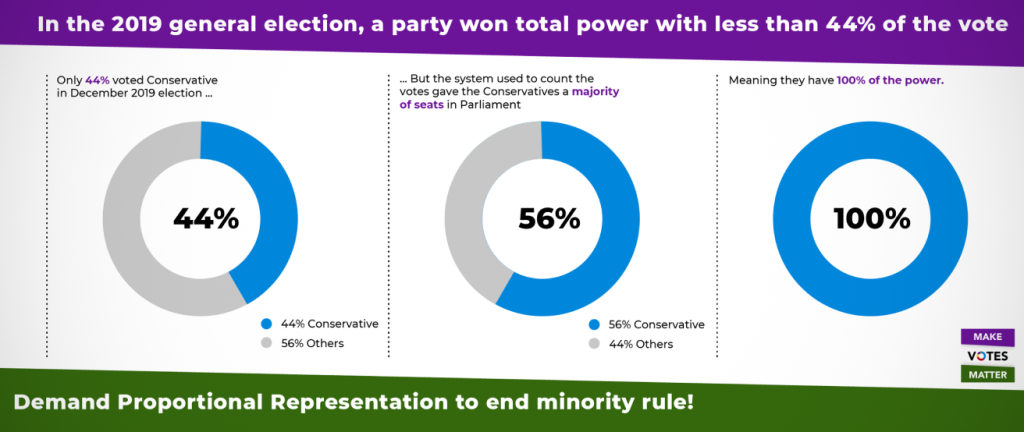
Since returning to power in 2010, Orbán’s government has made a series of changes to how elections work. The number of seats in parliament was reduced, constituency boundaries were redrawn, and the system kept single-round, winner-takes-all contests in local districts. That last point is key. It means candidates can win without a majority, especially when opposition votes are split, something that will sound familiar to anyone used to the UK’s first-past-the-post system.
In fact, Hungary’s system has been pushed closer in that direction. It’s become more majoritarian, more dependent on who comes first rather than how many votes parties actually receive overall.
There are also additional quirks, like “winner compensation”, which give extra seats to the largest party based on surplus votes. Instead of correcting imbalances, these rules tend to reinforce them.
The overall effect is pretty straightforward: the system exaggerates victories.
You can see this clearly in earlier elections. In both 2014 and 2018, Fidesz secured two-thirds majorities in parliament with well under 50% of the vote. Even in 2022, with a united opposition, the gap between votes and seats remained stark.
The 2026 election has changed the political picture, but it hasn’t removed these structural issues. If anything, it highlights them in a different way. When political change comes through figures with roots in the dominant party, it suggests that the system is not just shaping outcomes, it is shaping the range of viable alternatives.
That gap really matters.
When a party can turn a plurality of votes into a supermajority of seats, it doesn’t just win; it gains the ability to reshape the system itself. Laws can be changed more easily, institutions can be reworked, and constitutional amendments can become possible without a broad consensus. Systems like this don’t just produce winners, they can entrench power.
In the wrong context, that concentration of power can go even further. It can make it easier for leaders to govern with fewer constraints, and harder for voters to hold them meaningfully accountable.
To be clear, Hungary’s situation isn’t just about its electoral system. Media control, political culture, and institutional changes all play a role. But the voting system hasn’t acted as a safeguard. If anything, it’s amplified those other pressures.
And Hungary isn’t unique in this.
Across different countries, there are examples of electoral systems producing outcomes that don’t fully reflect how people voted. Often, this doesn’t trigger an immediate alarm. The effects are gradual. Representation becomes slightly distorted, accountability weakens, and over time, those small shifts start to add up.
Which brings us to a bigger question: what should an electoral system actually do?
At its core, it should reflect the will of voters as accurately as possible. That’s why proportional representation is so often part of the conversation. By aligning seats more closely with votes, it reduces the chances of any one party dominating without broad support and tends to encourage cooperation rather than outright control.
Of course, no system is perfect. Strong institutions and an engaged electorate still matter enormously. But the design of the system sets the tone. It shapes whether politics feels competitive and representative.
Hungary is a reminder of how much that design matters.
Democracy isn’t just about holding elections. It’s about whether those elections actually translate public opinion into political power in a fair way. When that link starts to weaken, everything built on top of it becomes more fragile.
For countries like the UK, where debates about electoral reform are ongoing, Hungary shouldn’t just be seen as a distant case study.
It’s a warning of what can happen when the system stops properly representing the people it’s meant to serve.